Showing posts with label rituxan. Show all posts

Sunday, March 17, 2013

Bendamustine and rituximab: the verdict

The results are in. After five cycles of bendamustine (Treanda) and rituximab, which ended in mid-November, I can report that the treatment worked better than I expected.

As you may recall, I entered into it last July feeling a little desperate. My marrow was 90% impacted with CLL, my hemoglobin had dropped into the 7s, my platelets were dipping below 100, and thanks to swollen lymph nodes my abdomen looked like it was ready to give birth to three or four alien babies. You know, the big, ugly Sigourney-Weaver-attacking kind.

When chemo began I did not know what to expect. I knew a CR (complete response) was out of the question. I just hoped I wouldn't get a HAR (half-assed response), one so ultimately poor and useless that it would render all the time, pain, and money not worth it.  Especially in someone as heavily pretreated as myself, that kind of response was entirely possible. The disease tends to become more refractory to treatment as time goes on; you don't want a big, ugly failure to confirm your worst fears.

Well, I've now had a follow-up bone marrow biopsy and CT scan. And the bone marrow result was one I did not expect: a CR in the bone marrow, courtesy of a 5-color flow cytometry.

The CLL clones are there, just in numbers too few to analyze. The flow cytometry reveals "no specific diagnostic abnormality." Susupicious B cells comprise "approximately 0.1% of the total cellularity," or "too few to accurately assess clonality."

I have to admit that I just about fell out of my chair upon hearing the news. I was hoping, at best, for maybe 20% CLL in the marrow, a significant reduction, to be sure. But not one that pushes my CLL back to pre-diagnosis levels.

The CT scan of chest, abdomen and pelvis came out about as well as I might have hoped, but with less stellar results: Numerous swollen nodes are still there, especially in the retroperitoneum of the abdomen. The largest node is 6 x 4 cm, or about 2.4 x 1.6 inches. There are two others about that size, as well as numerous smaller ones.

What I am grateful for is that no huge cluster or mass of nodes was found; one can only wonder how bad things must have been at the start of chemo.

The spleen was also enlarged, 10 x 6 x 17 cm. 

An added bonus on the CT was what wasn't found: "The liver, spleen, gallbladder, pancreas, adrenal glands, and kidneys are unremarkable. . . . Lungs are clear." In other words, no new wrinkles to challenge me on top of the CLL.

Four months after therapy my peripheral blood continues to look good, with an absolute lympohoctye count of 0.8, hemoglobin of 12.3, and platelets at 153.

Like Caesar's Gaul, CLL is divided into three parts: the marrow, the peripheral blood, and the nodes. It appears that chemo pretty much flushed it out of the first two. It remains a problem and a challenge in the nodes and spleen, which is what I would have expected given my history. And my B2M remains high at 5.1, which indicates the disease won't be staying out of those other two compartments forever.

So now, the challenge is maintaining -- or building upon -- the remission I have. I had a good visit with Dr. Thomas Kipps in San Diego in January. More on that in my next post, as well as some thoughts as to where to go from here. 

But the headline is that the chemo was worth it and that the disease has been dealt a significant blow.

Thursday, January 03, 2013

Red cell rebound

I knew I was feeling more energetic recently when, after going up and down the stairs moving a dozen cardboard boxes, I didn't feel especially winded.

Contrast this with not all that long ago, when just getting myself up the 14 steps was challenge enough.

My latest CBC confirms what I suspected -- some six weeks after finishing Round 5 of bendamustine and rituximab, my red cells have recovered to the levels they were at before marrow impaction by CLL forced me into chemo.

With a hemoglobin of 13.3, I feel like a new man, or at least not an old one. After living for more than a year with steadily declining red counts that put me in the 7s at one point, I realize now the subtle effect that growing anemia can have. At a hemoglobin of 11 I can feel almost normal, but lacking the energy edge of 13. At 9 I can function, but need a nap and am loathe to take on physical projects. At 7, well, it's a strain to climb the stairs.

Platelets are at 134, about where they were when all this began. Absolute lymphocytes are at 1.8. Lymph nodes are significantly reduced and my weight is in the low 170s, where it has not been in two decades. I look a lot less pregnant -- sorry folks, no alien baby will be bursting forth this year.

So, my initial verdict on BR is that it worked pretty well on me. Considering that I am ten years into this fight and have had multiple treatments, it was reassuring to see that I responded and responded well.

I'll be paying a visit to CLL expert Dr. Thomas Kipps next week and will be curious about his take on my response, as well as the state of my abdominal lymph nodes via a thorough physical examination. 

I'll also ask him about possible maintenance treatments and/or treatments at relapse, including what may be available in clinical trials. One thing I am certain of is that I do not want the disease to get out of hand as it did in 2012; B-R has not been easy and there is no guarantee that I will respond well to it in the future. 

My local oncologist is floating the idea of Campath, aka alemtuzumab, for maintenance. He's aware that it doesn't do much on nodes larger than 5 cm, which I may still have somewhere. And since bulky disease has always been my problem, I am a little loathe to go this direction.

What's more, Campath is severely immunosuppressive, killing off T cells as well as B cells, and leaving some CLLers with all the immunity of your average AIDS patient. I have had pretty good quality of life when it comes to avoiding nasty infections, and I am not disposed to open myself up to juggling pneumonia, shingles, and who-knows-what-else.

The extensive rash I wrote about in my last post has finally gone away with the help of a two-week course of oral dexamethasone. The biopsy came back as "hypersensitive dematitis" with no sign of CLL infiltration. Which is what I figured before the dermatologist punched holes in my skin.

My oncologist thinks the rash might have been an allergy to Rituxan, perhaps less so an allergy to bendamustine. But no one knows for sure. 

So I have one last question for Dr. Kipps: Is it worth doing the last round of B-R, and doing it more than a month behind schedule? My tendency is to go for it, if this is my best shot at using it to nail down the best remission possible, perhaps without the R, just to stay on the safe side of any possible rash. 

Meanwhile, I still have more boxes to move. It's the simple things in life that count and it's good to feel like a human being again.

Monday, September 24, 2012

Bendamustine & rituximab, round three

My third go-around with bendamustine (Treanda) and rituximab is over, with some notably different reactions than before.

The main event involved a 14-hour bout of diarrhea, which began the night of the second bendamustine infusion. I will spare you the details. But it is appropriate here that I say "Thank you" to the makers of Imodium, which I now regard as one of the Ten Wonders of the Modern World, ranking somewhere after the automobile and somewhere before air conditioning.  

(FYI, according to the chemo nurses, you can take an Imodium pill every two hours, despite what it says on the box. That schedule proved quite effective.)

Otherwise, Round Three went off without the infusion reaction to Rituxan that characterized the first two rounds, probably because I was premedicated with enough Benadryl, Demerol and Solu-Medrol to bring down a rabid tiger.

Round Three brought some noticeable reduction in abdominal lymph nodes, which I had been hoping to see as the treatments progressed. I am now one loop tighter on my belt. I still have a long way to go in the abdominal nodes department, but this is encouraging. Three more cycles of B&R await me; I am guessing that I won't get a complete remission but I may get as much of a remission as I could have reasonably hoped for.

Blood counts remain decent, with hemoglobin in the 10s and platelets around 110. Dr. Droll says the numbers should go up as the treatment progresses. My absolute lymphocyte count remains laughably low.  (UPDATE: As of my Oct. 1 CBC, ALC is 0.9, hemoglobin has risen to 11, and platelets are at 204, the highest they have been in years.)

The post-chemo fatigue and nausea that I wrote about following Round Two were there again, but in milder form. It's Monday, and the last infusion was Wednesday of last week, and I am feeling normal again, or as normal as I get.

Wednesday, August 29, 2012

Holy bendamustine, Batman! (B-R round two)

I have finished the second of my six bendamustine-rituximab treatments, and this time the regimen came with some "Kapow" and a little "Bam."

To guard against tumor lysis, my first treatment involved only two-thirds of the standard dose of bendamustine (aka Treanda); this time I had the full 100mg/m2. My reaction was significantly more intense than the easy-breezy first time around.

The bendamustine was administered last Tuesday and Wednesday. Tuesday also included the Rituxan, which brought forth infusion reactions unlike any I have had before. The ill effects of the bendamustine -- fatigue and low-level nausea -- didn't set in until Thursday night, and have only really abated today.

More on that later. First, there is good news to report. The higher dose has done a much more noticeable job on the nodes, almost returning my neck to its natural swanlike appearance, and reducing a large mass in the abdomen to a reasonable degree. I still have a long way to go with the nodes, but if this keeps up, I will have made significant progress by the time I'm through.

One question is how long the nodes will stay at their current size. Last time around, they began to bounce back in the week before my second treatment. By the time I sat down in the infusion chair, most of the progress that had been made thanks to the first round had been erased.

This is not a good sign, and it indicates how fast my disease is prone to grow. But my reaction to round two, with a much more noticeable node reduction than round one, makes me cautiously optimistic that the effort will hold this time. Which, fingers crossed, means round three should see an overall further reduction in the nodes.

I am hopeful that the cumulative effect of the treatments will largely shut down the CLL factory in the marrow as well as reducing it in the nodes, creating a smaller, more easily manageable disease.

A FISH story


For some time I have wondered if my disease has turned more aggressive, or whether it has reached a critical mass, like a snowball rolling downhill, gathering size until it gets so big that it is difficult to stop.

A first step was to get a new FISH test, which I did in April. Would there be a 17p deletion there, indicating more aggressive disease?

The results were a little surprising. My first FISH test, back in 2004, showed a "normal" karyotype, which meant the chromosomal damage was of a nature not probed for on the test. In 2006, the FISH came back positive for the 11q deletion on 24% of cells examined, not good news. 2007's FISH showed 11q in 36% of cells. 2008's FISH showed 11q on 53% of cells. In 2009, 11q was noted on 31% of cells examined. (Why the dip? Who knows? But it didn't change the basic picture: an 11q deletion that appeared to have increased in the number of cells over time. By the way, the deletion always showed up on one arm of the chromosome only, which was of some comfort, as it meant I still had some ATM function, ostensibly.)

2010 and 2011, the Revlimid years, were FISH-free as the disease was under control for most of the time. Then in April of this year came an interesting twist: the 11q was down to 8% and a new deletion, 13q, again on one arm of the chromosome, was found on 30% of cells examined.

That FISH test was from the peripheral blood. In July, I had a bone marrow biopsy, which showed 90% involvement by CLL. A FISH was performed on that sample. It showed no 11q deletion at all, and a 13q deletion on 42% of cells.

So, what does all this mean? It appears my 11q clones are in decline, which is good news. (Why that is, again, who knows? It appears to fly in the face of conventional wisdom. My hunch, which is a completely wild guess, is that my Revlimid treatments had something to do with it.)

The April FISH showed a double deletion (11q and 13q), which is not good news. And while 13q is considered the most benign of the deletions, there are a couple of flavors of 13q. One indicates more aggressive disease; the tests I had did not go beyond the basic probe, indicating a deletion of one arm of 13q14.3.

I don't think the handoff from 11q to 13q indicates an improvement in my disease. But this is about the best change I can hope for; it would seem to indicate that the disease is probably not more aggressive by nature than it was before.

So I am basically subscribing to the snowball theory, and only time will tell if I am right. Another point I am compelled to make: FISH tests are all well and good, but shy of showing a 17p deletion, the most important factor in deciding to treat the disease is your clinical condition.

On the way from Calais


The last time I recall feeling as nauseous as I did post-bendamustine was many years ago on a boat from France to England. This was in the pre-Chunnel days. I grew whiter and whiter as the white cliffs of Dover approached, barely managing to contain my nausea with each bumping wave.

The nausea that set in last Friday never got to the barfing point, but it was uncontrollable with ondansetron (Zofran) tablets, which worked less well than Pepto-Bismol. To keep my kidneys flushing the dead CLL cells through, I needed to be drinking lots of water, and water is the last thing a sensitive stomach can tolerate. If I never see another can of Blue Sky New Century Cola again, it will be too soon. Needless to say, food was also rather unwelcome; I managed to lose some noticeable weight since nothing was appealing, although my stomach eventually discovered that macaroni and cheese was tolerable.

The fatigue was also way out of the ordinary. I would sleep 14 hours, on and off, and wake up tired. Today, Wednesday, is the first day that feels normal, both in terms of fatigue and nausea.

Although it sometimes felt as if my hemoglobin had taken a hit -- benadamustine can lower hemoglobin temporarily in about 90% of cases -- it turned out that wasn't the case. Comparing some numbers from the day before I started the second round to six days after I finished it: hemoglobin 10.8 before, 10.5 after; platelets 147 before, 138 after; absolute neutrophils 4.9 before, 5.4 after (as in the first round, I had a Neulasta shot on the day after completing treatment). The only dramatic change was in absolute lymphoctye count: 13.6 before, 2.1 after. I don't think my ALC has ever been so low.

UPDATE: My blood work from two weeks after treatment showed signs of decline in hemoglobin (down to 9.3) and platelets (110). Absolute lymphocyte count was 1.4, a new record low.

The rigors, minus the mortis


Last Tuesday's plan was to infuse the rituximab, then the bendamustine. My reaction to rituximab, a drug I have had countless times, was surprising. I was given prophylactic Benadryl and Solu-Medrol and expected pretty smooth sailing. About 15 minutes in, my face turned red and I felt some shortness of breath. This eventually abated, thanks to stopping the treatment, accompanied by some oxygen.

About 10 minutes after the infusion resumed, I experienced what the chemo nurses called "the rigors." This symptom was appropriately named, as it involved rigorous uncontrollable shaking. You can wear out your thigh muscles fast when this happens. Imagine having "the chills" but it's all coming from an internal place, so it doesn't matter how many blankets they pile on you, you still can't get warm. I think the rigors lasted about 15 or 20 minutes, during which time I found myself wondering whether this was what the passengers on the Titanic went through when they fell into the icy Atlantic. It finally abated, thanks to some more Solu-Medrol and Benadryl, as well as some Demerol. The Rituxan was stopped and I was given the bendamustine; reversing the order sometimes helps in such cases. Sure enough, when the Rituxan infusion was resumed later, it was completed without incident.

Why would someone who had managed to accommodate Rituxan for years with minor reactions, if any, suddenly develop these sort of symptoms? Again, who knows? With groundless abandon, I theorize that Revlimid changed something in my immune function. The Revlimid put an end to my autoimmune hemolytic anemia, but also led to a more hair-trigger allergy response in terms of skin rashes. Perhaps it also created a microenvironment less friendly to Rituxan.

My next sojourn in the chair is scheduled for mid-September. Keeping my eyes on the prize, I look forward to making more progress against the disease. But I'm not counting on an easy ride, and I will lay in a supply of macaroni and cheese, just in case.

Wednesday, August 01, 2012

Off to a good start with bendamustine and rituximab

I have just completed cycle one of six in my bendamustine and rituximab treatment and things are going well.

These drugs are also known as Treanda and Rituxan. "Treanda" sounds like a girl's name from the Maury show, but to my mind it is cyclophosphamide's big brother, an alkalyting agent with a powerful kick. Rituxan, of course, is the ubiquitous anti-CD 20 antibody that we CLLers have been using alone and in combination with chemotherapy for several years.

I'm pleased to report that the treatment is showing the signs of effectiveness that I had hoped for, with only a few bumps in the road. The best news is that it cleaned out my bone marrow enough on the first go-around that I am making more red blood cells and am getting out of the anemia rut that came with marrow impaction. I entered treatment with a hemoglobin of 7.8 and less than a week later I'm at 11.4.

Not a lot has been written about patient experiences with BR in chronic lymphocytic leukemia, so I will describe mine in some detail. Remember that this is an anecdotal report, and that your mileage will vary; but perhaps I'll be able to give you some idea of what BR is like, and some of the things to consider and watch out for.

My first thought is that how you manage treatment is important. This should be a no-brainer, but people with no brains are dishing out chemotherapy every day, sometimes to the great disadvantage of the patient.

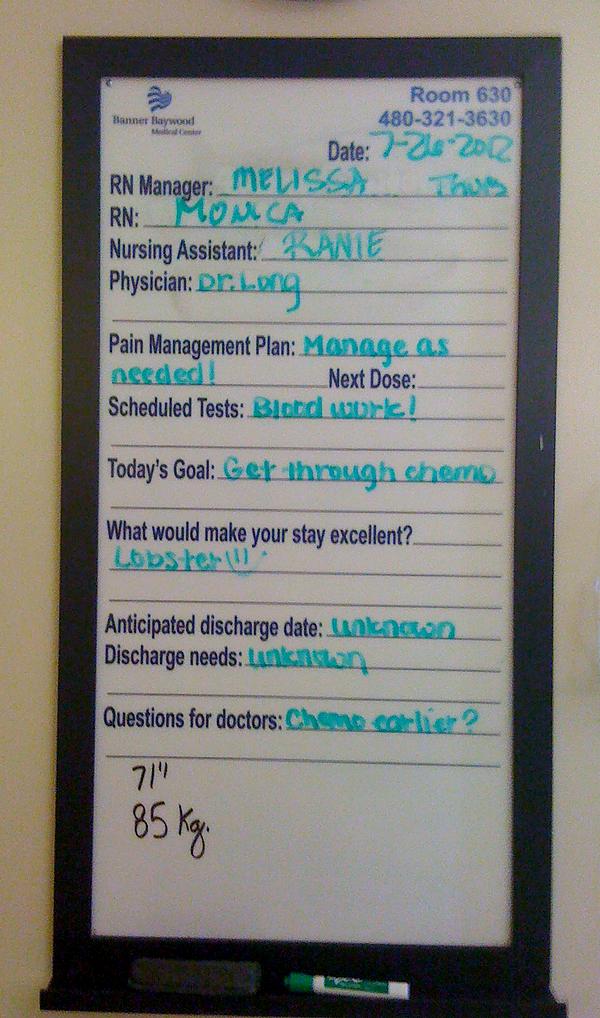
Going in with bulky disease and a bone marrow packed with CLL, my oncologist, Dr. Droll, felt it was best to start treatment at a lower dose and to do so in the hospital. I spent three nights at the lovely Banner Baywood, the name of which evokes a resort hotel (which no doubt would have been a lot cheaper), in Mesa, AZ. I was monitored for tumor lysis syndrome, which can occur when there is so much cell-kill that the kidneys are damaged. The hospital also kept track of my hemoglobin; bendamustine is known to reduce hemoglobin temporarily in about 90% of cases; it turned out that I needed four units of blood.

The photos I've posted show the room that was my home at Banner Baywood, which is a short walk from Dr. Droll's office. I was on the sixth floor cancer ward in a private room, since I was receiving chemotherapy and sharing a room could have, in theory, exposed the other patient to dangerous drugs The nurses could not have been nicer, and Marilyn stayed by my side the whole time, sleeping in a fold-out chair that reminded us of an uncomfortable cuchette that we once endured on an Italian train. I urged her to consider checking into a hotel, but love is stronger than a comfy mattress.

It helps to have a good caregiver with you, someone to watch you for infusion reactions that you may not be aware of, someone to keep an eye on what is being done, to get questions answered, to be there during the uncertain or scary times, and to raid the refrigerator at night when you want an egg salad sandwich.

Tuesday, July 24th began with a call from the hospital at 9:40 a.m.; a bed was ready. We pulled ourselves together and drove the two-and-a-half-hours to Mesa, a city east of Phoenix. We arrived at about 2:30 p.m. I was weighed, my height was recorded, and this was duly noted on the dry-erase board that serves as the information center in the hospital room.

I also had my vitals taken -- blood pressure, pulse, oxygen level, and temperature -- for the first of what seemed to be about six thousand times. One thing you learn quickly in the hospital is that you're not going to get a lot of uninterrupted sleep; there's always someone doing a vitals check, or drawing blood, or one of several other things that can leave you feeling very unrested. One morning between 6 a.m. and 9 a.m. we counted twelve visitors, including the chaplain, the "patient navigator" from the American Cancer Society, and, of course, the hospitalist. The hospitalist is the doctor who is in charge of the ward, although he had nothing to do with my treatment. I call him Dr. Ka-Ching, because I will no doubt owe him at least $500 for the 45 seconds he spent with me each day.

My first set of vitals put my blood pressure at 134/68, heart rate of 97, temperature of 36.8 Celsius (98.6), oxygen level of 95%. What's interesting is that once I started chemo these numbers immediately improved, and stayed improved, throughout my stay. My systolic pressure would typically be about 115, and the diastolic remained in the 60s and 70s. Oxygen level went up a tick, heart rate dropped into the 70s.

Dr. Droll came by and said he was lowering the bendamustine dose by one-third. Instead of 100 mg/m2, I received 65 mg/m2, which was modified by the hospital pharmacist to 125 mg per infusion. The doctor also said he wanted me to stop by the office on Friday for a Neulasta shot, which is a good precaution when using bendamustine. B can clobber the neutrophils, leaving the patient subject to all sorts of bad reactions that can put you in the ER.

To guard against tumor lysis, I was advised to continue on allopurinol (300 mg/day), which I had been taking for four days. (Please note that there can be some skin issues when allopurinol is used with bendamustine. I haven't had any problems, but it's something to watch for. According to an FDA warning letter to the drug's maker, Cephalon, "Allopurinol has also been used during the beginning of TREANDA therapy. However, there may be an increased risk of severe skin toxicity when TREANDA and allopurinol are administered concomitantly.")

I was also advised to stay well hydrated, which would keep dead cells moving through the kidneys. I was put on a saline solution, dispensed at 150 mg per hour, with some variations in speed over the next few days, and my urine was monitored. I was asked to pee into a plastic urinal with numbers on the side, and the nurses duly recorded the volume to make sure that my output equaled my intake. Everything I drank was monitored as well.

Dr. Droll exited stage left, announcing that he was going on vacation, and that one of his partners would visit me each morning.

Rituximab, the big unknown, was infused first. I have lost track of how many infusions of Rituxan I have had since I first used it in 2004. I am guessing about two to three dozen, give or take a few. One of the big questions going in was whether R would work on me at all, as it had, over time, become less and less effective. But I had not had it in 2 1/2 years, and research shows that in the presence of bendamustine it can work in Rituxan-refractory patients.
I'm still waiting for the lobster.

Premeds consisted of 25 mg of Benadryl and two Tylenol. No steroids were given, which I questioned, since in all previous instances I had been given 125 mg of hydrocortisone or Solu-Medrol.  The chemo nurse said that steroids were in Dr. Droll's orders "if needed" and that at Banner Baywood it was routine practice not to give steroids as prophylaxis before infusing rituximab.

"What strange corner of Mesa have I stumbled onto?," I wondered. But I figured I'd go along with the program, when in Rome and all, having never had a really bad reaction to Rituxan. Sometimes during the first infusion, about 40 minutes in, I would get a flushed face or some tightness in the throat. A couple of times this led to a temporary halt in the infusion, and/or giving more steroids. Then things would calm down and be uneventful the rest of the way.

Sure enough, about 40 minutes in, I began to react. This involved profuse sweating and shortness of breath, and I do mean shortness of breath. My blood oxygen level dropped into the high 80s. Not since I almost drowned in a swimming pool as a child have I felt that close to being unable to breathe. It was scary. I was hooked up to oxygen and the nurse proceeded to go about getting some steroids in me. I was given 40 mg of Solu-Medrol, the maximum that Dr. Droll's orders indicated. I needed more, and this took a little while to arrange, since Dr. Droll's Partner had to be reached by phone to agree to exceed the dose set by Dr. Droll, which he did. Another 100 mg of Solu-Medrol was administered and it worked.

Suffice it to say that Dr. Droll and I are going to have a conversation about Rituxan premeds and that at least two chemo nurses at Banner Baywood are now aware that CLL patients ought to be given steroids as prophylaxis when Rituxan is used. 

The good news is that Rituxan showed signs of working almost immediately. In the old days, when I used it as a single agent, there would be some tumor flare in my neck after a couple of hours. The area with the nodes would also turn a little red. The idea is that the body was responding to an area where there was now an antibody, cell-kill was ensuing, and this was part of the process by which the nodes were reduced. In later infusions, when I wasn't sure that Rituxan was working, this reaction would be absent. But sure enough, it was happening again, and I had not yet had bendamustine, so it was not the product of that drug's influence. Call it chance, call it luck, but it was a very good sign.

Bendamustine was started at 12:47 a.m. In the hospital they can give chemo 24/7, and they do. The Rituxan had taken forever, from 5:20 p.m. to 11:30 p.m. Premeds for the B consisted of 12 mg of dexamethasone and 24 mg of ondansetron (generic for Zofran, an anti-nausea drug), as well as 40 mg of Lovenox to prevent clotting.

The B was started at 10 ml/hour and was raised incrementally to 400 ml/hour, and it took an hour and a half to infuse. The chemo nurse kept track of the vein in my left arm into which all of this was pouring; I have never had a port, and I am evidently some sort of God when it comes to having good veins, but she wanted to make sure the vein did not blow, which can happen with rapid bendamustine infusions.

All went well. She may as well have been infusing me with water for all the reaction I had, which was no reaction at all. After the Rituxan it was anticlimactic, and I had had enough drama for one evening.

There was, however, to be no rest for the weary. I entered the hospital with a hemoglobin of 7.8 and Dr. Droll's orders called for a red blood cell transfusion if the hemoglobin was below 8. So I was given two units of blood, taking about three-and-a-half hours each.

The blood was irradiated, CMV negative, with leukocytes removed, so it was about as pure as it was possible to get. I had no infusion reactions and did finally manage to get some sleep, although the entire process was not finished until about 9:30 a.m. the next day.

I should note that these days, at least at Banner Baywood, the patient armband has a UPC code; nurses use a scanner on it that verifies who a drug is for (and no doubt adds it to the bill.) This also tells them if a drug is contraindicated with another that the patient has been given. A separate armband is used for blood products. When blood was transfused, two nurses would come in and, in addition to the scan, repeat my name, date of birth, blood type, and so on to verify that the right person was getting the right stuff. I appreciated this attention to detail. There is enough to worry about when doing chemo without having to worry that you're being given something by mistake.


Day Two involved the second and last bendamustine infusion as well as two more units of blood. All were uneventful in terms of infusion reactions.

The blood was ordered because my hemoglobin, which had been raised by 1.6 points thanks to the first two units, had again slipped below 8. Given that bendamustine takes a toll on hemoglobin in 89% of cases, it was not surprising that the number didn't hold. (My platelets were taking a hit as well, having been 127 upon admission and 71 on discharge. This drop occurs in 77%-86% of cases. Absolute neutrophils actually increased, which is something of an anomaly, from 1.82 to 2.42. Neutropenia is reported in 75%-86% of cases.)

Dr. Droll's Partner stopped by with another theory; perhaps I was being so well hydrated to avoid tumor lysis that it was causing the hemoglobin number to drop. It is true that if you want to increase your hemoglobin on a CBC, going into the test dehydrated will help. So he cut the flow rate of the saline solution to 60 ml/hour and said he wanted me to stay in the hospital one more day to monitor the situation. This prospect was not greeted with huzzahs by me or my loved one -- the chemo nurse was amused to learn that a sweet-looking lady can curse like a sailor -- but we understood the reasoning.

Sure enough, the next morning, my hemoglobin was 9.0 and I was a free man.

I feel significantly better following the chemo. That's the bottom line, after all. I have a great deal more energy, thanks in part to that 11.4 hemoglobin. I feel as if I have my life back; I can do things around the house again, run errands and not get winded, and so on. I'm not ready to run any marathons, but things feel more normal than they have in some time. Perhaps the CLL was taking an overall toll on my system that helped account for my low energy on top of the low hemoglobin; putting it in check has done more in a short time than I expected. It is interesting that my heart rate dropped so dramatically -- from the 90s to the 70s -- after therapy.

My major challenges are the lymph nodes and bone marrow. There are five more cycles to go and I am optimistic that I will have a significant reduction in nodes. Odds are very good that I am among the bulkier CLL patients ever to use BR. My nodes tend to be smaller, but they fuse together in clumps when left unchecked. Treatment then breaks them up. Already the neck nodes are noticeably and significantly reduced. The masses that were under my arms are now individual, smaller nodes, though still significant. My abdomen has slimmed down and I look a mere seven months pregnant instead of nine. I have lost about five pounds, much of which is probably lymph node weight.

My white blood count, which is really the least of my problems, dropped from 71.7 to 12.1 on discharge and 8.2 four days after discharge. Platelets have begun to recover as well, now at 112, up from 71 at discharge. The Neulasta bumped absolute neutrophils up to 4.7. The hemoglobin, which was 9.0 after the last two units of blood, is at 11.4 four days later. That is the highest it has been since last December and I am surprised, in a good way, at the rapid turnaround.

I managed to avoid tumor lysis syndrome as well. I picked up a few things from the nurses on what they look for. In extreme cases they see signs of mental confusion, but I was no more confused than I usually am. They also pay attention to creatinine levels, uric acid, and electrolytes such as potassium, magnesium, calcium, and phosphorous. At one point my magnesium and phosphorous were a little high and calcium a little low, but nothing to worry about. The other numbers remained within the normal reference range. 

One thing I noticed on the tests that has been little-discussed is a rise in blood glucose levels. Back when I used to do RCD -- rituximab, cyclophosphamide, and dexamethasone -- to combat autoimmune hemolytic anemia, my glucose levels would rise. My oncologist at the time, Dr. Meng, said this was mainly due to the cyclophosphamide, which can cause hyperglycemia (although I am sure the steroids contributed as well).

Diabetes is not an issue for me and in a fasting state I test out at normal glucose levels. I can eat a turkey sandwich before a blood test and still have a glucose level that's not far over 100. But in the hospital, where I was not fasting, the glucose was coming back at 229, then 185, then 175. (Four days later it was 109 in a fasting state.) Given that bendamustine is an alkalyting agent like cyclophosphamide, those of you with blood sugar issues may want to keep an eye on things if you opt for BR.

I have found a few good resources on BR. There aren't many out there for a therapy that is becoming increasingly common. The best I have found on dosage and side effects is this document from the Veteran's Administration. The ever-helpful BC Cancer Agency also has a good PDF on bendamustine. The best paper on BR is Bendamustine Combined With Rituximab in Patients With Relapsed and/or Refractory Chronic Lymphocytic Leukemia: A Multicenter Phase II Trial of the German Chronic Lymphocytic Leukemia Study Group. The abstract can be found here. If you want more than the abstract, send me a note at clldiary at yahoo dot com. I'm not always swift about replies but I promise to get back to you.

I am looking forward to my next treatment, which will be in Dr. Droll's office, with full-strength bendamustine. I'll report on what happens then, and whether I experience any delayed reactions to the treatment I have already had. Some patients have reported nausea, fevers, fatigue, rashes, constipation, diarrhea, and severe neutropenia. Some of this is a matter of luck (or lack of it) and I think age may also have something to do with how easily the medicine goes down. It's easier to handle heavy-duty chemo at 55 than at 75. Whatever your age, of course, the important thing is that it works. So far, so good.


Sunday, October 10, 2010

If pigs could fly, we'd all choose the perfect treatment

There was an interesting exchange in the comments section of Dr. Terry Hamblin’s recent blog post The ultimate FCR advice. 

The post concerns a pivotal study of 817 patients by the German CLL Study Group. The investigators conclude that there is a survival advantage for most patients who use FCR as frontline therapy and that FCR can change the natural course of chronic lymphocytic leukemia.

The respected study shows that FCR is more effective than FC, meaning that the addition of rituximab is essential to getting the best results. 

The exception to the “FCR is golden” rule is those patients with dysfunctional TP53 pathways, including those with the 17p deletion. FCR needs a functional cell-kill pathway to work, and giving FCR to these high-risk patients is so counterproductive that, Dr. Hamblin indicates, it crosses the line into criminal incompetence.

Of particular interest to my 11q-deleted self is that the our group responded well to FCR. Says Dr. Hamblin: “It is important to recognize that the del 11q patients now fall into this intermediate group. CLL8 has removed indecision as to whether they should be intermediate or high risk. If they are getting FCR they are at intermediate risk.”


All of these are big bullet points in the world of CLL.

After reading Dr. Hamblin’s analysis of the study, one reader was still not convinced that FCR is a good way to go and left this comment:

“Unlike Dr. Hamblin, I don't think FCR should be used as a first-line therapy. Why? Because when the patient relapses (and he will relapse), he will be in a precarious situation indeed. Fludarabine-refractory disease means that the patient has a poor prognosis.

 “My opinion is that there are many treatments now available that are more benign than FCR. These include HDMP+Rituximab, Revlimid+R, flavopiridol, EGCG and others. Clinical trials using such agents as CAL-101, ABT-263, Perixifor+R and others could be considered as well.

“When you use FCR, you shoot the whole wad. Why not try something less toxic to start?”

(I don’t want to get sidetracked here, but except for Rituxan, steroids, and perhaps Revlimid, most of the treatments mentioned above are not feasible for most patients, few of whom have access to clinical trials. EGCG is not a reasonable alternative as it doesn’t appear to do much except in the most indolent of cases.)

Here’s Dr. Hamblin’s reply:

“None of the treatments you mention has ever been compared to FCR so you are asking people to buy a pig in a poke.

“It is true that we don't yet know where to go after FCR, but that is the time for all your experimental treatments.


“I'd rather buy my pig in a poke after I'd been eating roast turkey for 10 years.”

The first thing that ran through my mind is this: It wasn’t that long ago that FCR was the pig in the poke.

* * *

I was diagnosed in 2003, seven years and one month ago. At the time, all I knew is that I was CD38 negative, a good prognostic sign. None of today’s other important prognostic tests -– IgVH mutational status, ZAP-70, FISH -– were available to me. Our CLL researchers were still examining those pigs.

MD Anderson was just starting to report good news about FCR, albeit based on retrospective studies that came in for some criticism. People were intrigued by the results but a little wary of MDA’s pig farming techniques. The German Study confirms that MDA was basically right, even if some of the I’s weren’t dotted and some of the T’s weren’t crossed.

The idea of risk-adapted therapy in CLL was just gaining a foothold. It may be hard for today’s new patients to believe, but most doctors used to make treatment decisions in the dark. They assumed all CLL cases were basically the same,  and pretty much treated everyone with the same thing (chlorambucil, and later fludarabine).  
Clinical symptoms were used to decide when treatment should begin, which is the one thing that has not changed, nor should it. A recent editorial in haematologica includes this comment:

“In spite of this clinically relevant risk hierarchy, the decision to treat is currently not based on the risk profile but on symptomatic disease.  This is important and further supported by the observation that in some subgroups of patients, such as those with 17p deletion (and mutated IGHV), the disease may have an indolent course.”

In other words, we know a lot more thanks to prognostic tests, but the most reliable bottom line resides with symptoms such as swollen nodes, dropping hemoglobin, dropping platelets, frequent infections, and lymphocyte doubling time. Assumptions -- such as “all 11q patients are high risk” or “all 17p patients are screwed” –- may not always be correct. With CLL, the learning curve goes on well into the horizon. The more we know, the more we realize we don’t know.

* * *

So, back in the Dark Ages, I was faced with a decision: FCR or single-agent Rituxan?

My disease looked more like an indolent thing that had finally started getting out of control than it did a goose-stepping disaster. After I was diagnosed, I recalled my last CBC –- from 1996 -– and began to suspect that I had CLL back then. The results showed my lymphocyte count to be a little high, which was chalked up by my doctor at the time to me having an infection, even though I didn’t feel sick.

In 2004, when I got my first FISH result, it gave some credence to the relatively-indolent theory. My result was “normal,” meaning whatever chromosomal damage I had was not on the test. I was not 17p-deleted, nor 11-q deleted.

But because of clinical synptoms –- swollen spleen and nodes and a high lymphocyte count –- the doctors I was seeing seemed to agree that I needed some sort of treatment. Two years later, CLL expert Dr. John Byrd told me I probably could have waited awhile longer, and in retrospect I think he was right. (This is why I suggest all new patients see a CLL expert doctor or two before deciding when and how to treat.)  But at the time I was living in the universe of knowledge that I was living in. 


Do I chose the pig in the poke? Or the other pig in the poke?

FCR struck me as overkill given what I knew about my disease. It was also fraught with questions about side effects and after effects. These weren’t so evident in the early days, and we have learned a lot since: FCR can severely weaken the already weakened immune system, giving rise to a host of problems. Viral reactivation can lead to Richter’s Transformation. Potentially fatal pulmonary problems can develop. Myelosuppression can be severe. Autoimmune hemolytic anemia (AIHA) can result. And so on. FCR has a bit of a Russian Roulette aspect, assuming your gun has about 30 chambers.

The other pig was single-agent Rituxan, also new and virtually untested as a treatment concept. The remission wouldn’t be as good or as long, but the side effects and risks were much more benign. Since it was a soft-glove treatment, it seemed reasonable to start it sooner rather than later, when the disease would be even more out of control.

So that’s the way I went. I responded pretty well for a couple of years, during which I also learned that my disease was worse than I had thought: I tested positive for 11q, I was IgVH unmutated, I was ZAP-70 positive.

* * *

Dr. Byrd also told me that CLL is a long journey, and that the nature of that journey is profoundly influenced by your first treatment.

If I could go back to 2003, armed with the results of the prognostic tests that I have had since, as well as the results of the German Study and other clinical trials conducted since,  would I have chosen FCR?

Probably. Given the full scope of my prognostic markers, the argument in favor certainly would have been stronger. And the weakness that single-agent Rituxan has demonstrated in most patients over the long haul would have made that option less attractive.

Knowing that FCR would be my first treatment, and having had the sense to see Dr. Byrd at the outset, I might have been able to wait another year, perhaps even two, before undertaking it. Judging by the way I first responded to single-agent Rituxan, I probably would have gotten a CR, and the remission probably would have lasted a good three to five years but no longer. We know that unmutated folk like myself relapse faster. That card was dealt when the CLL was born.

Would my FCR experience have been uneventful, giving me years of “worry-free” living? Or would I have not dodged all the bullets that come with firing that big gun?

I have enjoyed relatively good quality of life along the path that I did choose, with the exception of coming down with AIHA in 2007. Might FCR have spared me that? Or might it have caused it to happen, as it recently did to a fellow patient I know?

Might the 11q have been avoided? Or might 17p have resulted from FCR’s selection of CLL clones with dysfunctional TP53 pathways?

Assuming all had gone well, I’d likely be in relapse now, on my second treatment, perhaps even a third. Ironically, I might be on Revlimid to keep the disease in check, which is exactly where I am.

Either path would have led me to the same place, namely the likelihood of needing a stem cell transplant to survive in the long term.

Either path is likely to have prolonged my life. The German Study cannot answer long-term survival questions: How many FCR patients will be alive after, say, 10 years, compared to others? A study in the 1990s showed that single-agent fludarabine led to longer remissions than chlorambucil, but as time went on, it became clear that fludarabine did not provide longer overall survival. Rituxan will probably make a difference in the statistics. But will it have to be part of a chemoimmunotherapy regimen (FCR) to make that difference, or will using it as a single agent also have an impact? 


I said before that I'd probably choose FCR if I could go back in time. It would be the logical thing to do given my prognostics and the options available in 2003. (Would I have tried  Revlimid first had it been a choice? Hmmm.) But there is no guarantee that, had I chosen FCR, I would be in any better shape than I am today.

My guess is that for patients with “mild” cases of CLL, FCR will prove more of a game changer than it will for us “intermediate risk” folk. It makes sense that the more you beat down something that doesn’t grow very fast, the longer it will take to come back.

Will a study conclude in, say 2018, that FCR increases survival of 11q-deleted, unmutated patients by three years, or three months, or not at all? (For that matter, will 11q deletion be an antiquated measure, having given way to some new, more specific way to understand what is driving an individual’s CLL?)

My point is that, as my experience demonstrates, CLL choices are ever-shifting. Nothing is frozen in time. And treatment results can vary greatly by individual because, on some level, CLL cases are as unique as fingerprints.

We are at the beginning of the era of risk-assessment, not the end of it. For all our knowledge -– and the light shed by the German Study should not be discounted -- we are still playing a guessing game. Given everything we don’t know, everything is still, to one degree or another, a pig in a poke.

So judge your pigs as best you can and hope that the one you choose doesn’t turn out to be a turkey.

Sunday, September 05, 2010

The OL protocol after six months

It was six months ago to this day that I first downed a Revlimid capsule. Cheers! Salud! L'chayim!

I was embarking on the pill half of my latest CLL treatment protocol: Arzerra (aka ofatumumab), the anti-CD20 monoclonal antibody; and Revlimid (aka lenalidomide), an immunomodulator. I call it the OL protocol.

As readers of this blog know, I had my challenges with the Revlimid: tumor flare, rash, fatigue. It's not a fun drug. My body got used to it, but I'm not sure I have. 

I'm just about to end a week-long, doctor-approved Revlimid treatment holiday. The OL protocol has me slogging through 10 mg of the stuff every day. In myeloma protocols, and in at least one CLL clinical trial that I know of, patients get three weeks on and one week off. During this week off I have slowly seen the drug-induced fatigue and dullness leave my body. I have more energy again and I'm mentally sharper. Revlimid subtly but surely detracts from certain aspects of quality of life. So the results had better be worth it.

Are they?

The results so far have been mixed, a combination of disappointment and relief, and might technically be considered to be "Stable disease Plus."

The disappointment has been in the lymph nodes, where most of my 11q-deleted disease resides. Back in May I thought I was finally having some luck in that department. But rather than presaging progress to come, it turns out May's results were an anomaly. Further treatment has not yielded any more progress. The nodes are pretty much where they were when I began. 

Which is to say they appear to be (with the naked eye and roving hands, as opposed to an abdominal CT scan) stable. While I was hoping for more, I have learned after seven years of fighting this thing to be content with treading water. It beats drowning.  

Nodes, like facts, are stubborn things, at least in my case. The only thing that will really blast them -- and I'm not at all confident that it would get rid of them completely -- is heavy-duty chemo. Steroids provide a nice reduction, but it is fleeting. The addition of cyclophosphamide provides a longer reduction, but not that long. FCR would probably do better, as would R-CHOP or the like. But the results would last how long? It's best not to take that sort of step unless I really have no other choice, and unless I'm prepared to roll the dice on a transplant afterward. But it is also best not to let the nodes get any worse, which means that keeping them stable, while not optimal, is important.

An area where the protocol has worked has been in the peripheral blood. My absolute lymphocyte count has been "normal" for months now, dropping from 11.8 on Feb. 23, the day before the protocol began with my first Arzerra infusion, to 3.2 as of last week. In clinical terms this means absolutely nothing. The blood is not where the disease is congregating. 

I have also been spared the neutropenia and thrombocytopenia that can accompany the protocol. My platelets, which have slowly dropped over the years, landing in the 120s a couple of years ago, have remained stable.

The really good news -- and the "relief" I mentioned above -- is that there has been no sign of autoimmune hemolytic anemia (AIHA) since I began the OL protocol. On the quality-of-life scale, dealing with sudden bouts of severe hemolysis of red cells has been the bane of my existence since the first incident occurred in early 2007. Over the course of time I became refractory to more and more AIHA treatments, including steroids and Rituxan. It was even getting to the point that the RCD protocol  (Rituxan, cyclophosphamide, and dexamethasone) was only holding me for three months.


Here I am, six months later, with normalized red counts, hemoglobin testing in the 13s and 14s, and no signs of orange pee or pounding in my ear. I can't leap tall buildings in a single bound, but I can at least climb the stairs with ease.

I am thinking that the Revlimid, doing its immunomodulating thing, is probably responsible, or primarily so. I had already become refractory to Rituxan, and Arzerra is a cousin of that drug. Dr. Chanan-Khan, the CLL Revlimid research guru, told me that he knows of two actively hemolysing patients whose situations were turned around when they were given Revlimid.

The take-home message to all of you fellow AIHA-ers is: Consider Revlimid.

This is the big "Plus" in "Stable disease Plus" and -- along with maintaining evident stability of the nodes -- is a big reason why I will continue to take the drug and work with the protocol. My doctor and I are discussing ways to tweak it or change it, given that it appears I will have no more progress with the nodes the way things are. The question is: What is the minimum dosage I need to maintain stable disease and keep the AIHA in its box? And another question: To what degree is the Arzerra contributing to this stability? And of course: Will upping the dose of Revlimid give better results on the nodes?

There are always more questions than answers in CLL.

Tuesday, February 09, 2010

My little OL protocol: ofatumumab and lenalidomide

Yes, that little ol' lab rat, me, is about to undertake a cutting-edge protocol to fight chronic lymphocytic leukemia: ofatumumab and lenalidomide.

I call it the OL protocol, and there’s a trial at MD Anderson in Houston that’s just starting to accrue patients for a two-year study of this new drug combination.

Thanks to a forward-thinking oncologist who is willing to fight like hell for her patients, and thanks to two drug companies that are willing to help those who can’t afford to pay the enormous costs of the treatment, I am going to be following that protocol from the comfort of home
, or at least from a comfortable chair two hours away.  I start next week.

Because I will be one of the first CLLers to try what could become an important  therapy
for our community, I will blog about my experience on a somewhat regular basis.

To briefly review, ofatumumab is the fully-humanized anti-CD20 monoclonal antibody that was approved for CLL in October by the FDA. It goes by the trade name Arzerra but old CLL hands (Man, I guess I am one of those!) may better know it as HuMax-CD20. It was developed by Genmab and licensed to GlaxoSmithKline.

Lenalidomide, which I wrote about in my last post, goes by the name Revlimid, and was developed by Celgene. It has been approved by the FDA for Myelodysplastic Syndrome and Multiple Myeloma and has had some interesting results in CLL.

December’s American Society of Hematology meeting included a report from MD Anderson on a trial of rituximab and lenalidomide in 37 relapsed and refractory patients, all of whom had used Rituxan in the past. The new OL trial appears to be based, in terms of timing and dosages, on their experience with RL.

Dr. Alessandra Ferrajoli and the team o' Texans reported an overall response rate of 68%, of which 51% received a Partial Remission and 16% a Nodular Partial Remission. Sixteen percent had stable disease and 16% failed the protocol.

Other studies have shown an overall response rate of 32%-47% among relapsed CLLers given single-agent lenalidomide, so MDA considered the combination with the monoclonal antibody to be “superior to single agent lenalidomide, despite all our patients having received prior rituximab.

“Additionally," the authors wrote, "there was no increase in toxicity and lenalidomide-associated tumor flare reaction was less frequent and less severe with this combination compared to single agent lenalidomide.”

For the record, a 2008 MDA study of single-agent lenalidomide in relapsed patients showed an Overall Response of 32%, which includes a Complete Response of 7%. An additional 25% achieved stable disease. A 2006 study by Dr. Asher Chanan-Khan’s group at the Roswell Park Cancer Institute in New York reported an Overall Response rate of 47%, with 9% achieving a CR. Another 18% had stable disease.
 

My prospects

Clearly, my response can fall anywhere on that rather large map, landing from CR to CRap. And just as clearly, this protocol is not going to be a cure for CLL nor an avenue to a molecular remission. But it may serve as a welcome and
effective control, and I have reason to be optimistic as I begin.

I have always responded well to whatever new drugs I have been given and there
is no change in my FISH profile that would indicate a loss of that ability. Of course, having had several treatments over the years, some disease resistance has developed in response. Indeed, the CLL cells have created a rather secure suburban community in my abdominal lymph nodes. The ability of lenalidomide to disrupt that micro-environment, including the nurse-like cells that help CLL remain comfortable, is a definite plus.

I am also younger and in better shape, both in terms of my health and disease state, than many of the participants in these trials. I can weather the side effects -- notably fatigue, tumor flare, and possibly low neutrophils and low platelets -- that may come my way.
Ofatumumab will assuredly be more effective on me than rituximab, to which I no longer respond well after many, many uses. Indeed, ofatumumab has given a new lease on life to any number of people who have tried it before me, some of whom I have known personally, and many of whom had stopped responding to Rituxan.

Readers may recall in my last post that I said I did not wish to use ofatumumab as a single agent, that it was too important a weapon to use gratuitously. That remains the case, and I don’t see the OL protocol as a wasteful extravagance.

I have a lot of abdominal lymph node bulk, enough that a year’s worth of steroids, Rituxan, and even cyclophosphamide were unable to make much of a dent in it. Ofatumumab is a new drug for me; with some luck, my nodes might respond the way they did to Rituxan when I first used it six years ago. In other words, they may undergo a noticeable reduction that can then be hammered home by the lenalidomide.

Can I completely clear the abdominal nodes? It would be quite a feat, but all things are possible in life and combination immunotherapy. Even if I can’t, can I reduce the bulk by a meaningful amount -- say 50% -- and throw my disease level back to where it was in 2005 or 2006? I think even hardened realists would say that is possible. The 2008 MDA study of single-agent lenalidomide reported a greater than 50% improvement in lymphadenopathy in 41% of patients. I'm probably starting from a worse position than most patients in that trial, but remember that we are also adding the ofatumumab.

Such a reduction in disease –- along with hopefully enhanced immunity, including a cessation of autoimmune hemolytic anemia, with its endless threat of hemolysis –- makes this an especially intriguing protocol.

Nothing else out there holds the prospect of doing all these things for me, especially with minimal toxicity, and these are all things that need to get done. For what it’s worth, some of the experts find this drug combination to be full of potential. I am told, for example, that MDA's Dr. Michael Keating is “very keen” on it. 

Perspective: Playing for time vs. transplant

It’s the right thing at the right time, as far as I’m concerned, which brings up an interesting point. When I was diagnosed in 2003, neither of these agents existed for CLL. Despite the feeling among us patients that progress can never come fast enough, here is a case where two new drugs may make a significant impact on my disease. So there is indeed some
wisdom in playing for time if you have the stomach for it.

Playing for time is something that you have to finesse as you go, since the disease is not static. Much depends upon your biological markers -- IgVH mutational status, chromosomal deletions per FISH, ZAP-70, and CD38. But the bottom line, which I think is sometimes given short shrift in patient discussions, is your actual disease progression, clinical history, and ability to respond to treatment. 


To my mind, it's the practical stuff that counts. Which brings us to the stem cell or cord blood transplant, sometimes seen as the CLL end game. For many of us, and maybe even yet for me, that will be the case. But I think it is a little premature to be swept along on some kind of bandwagon, thinking that transplant is inevitable and maybe even desirable. Perhaps, if meaningful control of CLL can be obtained by means of OL and other agents in the pipeline, some of us will have a realistic alternative.

Frankly, transplant results are virtually impossible to predict. Talk about arbitrary and capricious: You can die. You can be cured, or at least disease free for a long, long time. You can also relapse and have to wake up to fight the whole messy, draining battle all over again. You can struggle along for years with debilitating graft vs. host conditions, from skin reactions to gastrointestinal problems to seizures.  Many patients are grateful to be alive despite the side effects; others have regrets. 


One wrote to me off the blog: "Do not underestimate the effects of chronic GVHD. When you read about them, they might not sound too bad; however, the collective experience of multiple GVHD effects can make life after a transplant quite miserable.  And chronic, in this sense, must be seen as a permanent condition."

I will never forget Dr. Terry Hamblin's comment that he knew of two patients who were so beset by post-transplant graft v. host problems that they killed themselves.

There is a yin and yang to this, of course, and I am not discounting the success stories, those who write that they are "recovering nicely" after two years, and those who are a few years in with only minor problems, nothing to get too excited about, and with no regrets about having taken the big step. 

I keep a list of blogs on the right side of this page. Scroll down and click on those of the transplant patients: Brian Koffman, Jackie Sue, Ron Gottula, Dan O’Mara, and Harvey's Journal. Take a look at Tom McCune’s website; Tom was once the CLL cure “poster child,” now in relapse. Check the posts at CLL Forum and ACOR from patients like Chonette and JursyGurl, both of whom are having success with minimal trouble so far (you go, girls!). Read Raywood's Great Stem Cell Transplant Caper, and then read all the nice comments about him on CLL Forum's "In Loving Memory" page; Ray was a character, an irrepressible optimist and guitar picker who put CLL to Country music. But all the sunshine in the world doesn't guarantee success. Neither, for that matter, does a Vulcan-like level of meticulous preparation.


Gather all this –- and more -– into your head and you may conclude, as I have, that the transplant is unpredictable at best, freakishly difficult much of the time, and, obviously, fatal at worst. You may as well go into the hospital singing "Luck Be a Lady."

"They call you lady luck
But there is room for doubt
At times you have a very un-ladylike way
Of running out . . ."

I think the outcome is well out of your hands despite however many statistics you arrange in your favor (the optimistic configuration of published data can indicate an element of wishful thinking that creeps into even the most rational of minds.) When the chips are down, you're putting all your chips on the table. A transplant, to my mind, is something you do when you HAVE to do it and no sooner.

It is not a battle that I am afraid of, but it is not one I am jumping to fight if there is a wiser way to conduct the war. 


I am hoping that OL will be an effective weapon, something of a game-changer, at least for a reasonably long time. I’m 53, healthy other than the CLL -– my blood pressure tests out these days at around 120 over 70 and my primary care doctor wants to frame my lipid profile.  My quality of life is good (when I’m not hemolysing).

Beyond the medical facts, CLL has taught me that I am mortal, and so it has ironically given me the gift of being able to live life fully today, to let go of old regrets and unhealthy patterns, and I am happier than I have ever been.

So why not still play for time? 

There is a fine line in CLL between being too proactive and too reactive. Much of my CLL journey has been spent trying to find and stay close to that line. At times I have been more successful than others. I think -- I hope -- that I have found it with the OL protocol.

It's the line of scrimmage between me and the disease. It’s first-and-ten and I will move the ball down the field as best as I am able, however many yards at a time. I’ll report on it as I go.

Sunday, January 24, 2010

Treatment update: My new friend len

I suppose an update is in order. No news is good news when you have CLL, and I’ve had no news for awhile. Now I’m gearing up for treatment again, this time with lenalidomide, better known as Revlimid, also known as "len" for short.

All of last year’s treatments basically bought me stable disease. A CT scan comparison from January to September showed only marginal improvement in abdominal lymph nodes, which is where most of my 11q-deleted disease lives these days. Over time my CLL has become less leukemic, more nodal, and my blood lymphocyte count is practically normal.

I remain at Stage 2, for what it’s worth. When I’m not hemolysing due
to autoimmune hemolytic anemia (AIHA), my red blood count, hemoglobin and hematocrit remain well in the normal range for a man. I’ve not seen the slow decline in those counts that follow with progressing disease. Over six years my platelets have gradually dipped, settling now in the 120s. That’s just below what’s considered normal, absolutely high enough for full clotting function, something to note but not to worry over.

My latest FISH test -- I get one every year, and the results have a huge say in how I approach treatment -– still shows the 11q deletion only, on 31 out of 200 chromosomes. This is a monoallele deletion, which means the relevant bit is broken off of the long arm of one of the set of two chromosomes #11. A biallele deletion would mean that both of the chromosomes 11 have lost the ATM gene. So hey, I’ve still got one arm to hang paper with, it seems. (A cautionary note is worth inserting here: As we all should know by now, the FISH test doesn’t probe for all possible chromosomal abnormalities that may eventually prove important in CLL. No news is good news in my case, but it may not be all the news, if you know what I mean.)

So by some measures -– including how I feel on any given day -– I am just
sort of trucking along with this thing in neutral. But it ain’t quite so. There are those abdominal nodes remember, none over 5 cm, but a whole, whole lot of them. My B2M is 4.8, a little over the line MD Anderson sets (4.0) to divide between those with better disease and those with worse. For me, the action is taking place in the abdomen.

Plus I’ve got the AIHA, with its hemolysis shoe always waiting to
drop, a sign that CLL has gummed up immune function and still continues to do so. I also have squamous cell skin cancer issues. I've had two SCCs removed surgically since 2005, several actinic keratoses frozen off, and I am on far-too-intimate terms with a tube of Efudex. SCCs can be deadly serious in CLLers, whose T cell surveillance function is weakened, because it is T cell surveillance that helps keep those squamous cells in check. CLLer T cells take a hit because of the lowered immunity that accompanies disease progression, and they can further tank due to immunosuppressive therapy, notably fludarabine and Campath.

I haven’t had fludarabine or Campath, which brings us to the menu of choi
ces I now face:

Looking at all the data tells me that my disease is stable-ish but also growing, more or less behaving but capable of getting that much worse if I don’t atten
d to it. For years I attended to it with single-agent Rituxan, but AIHA changed that game and while Rituxan was clearing the blood the disease found other avenues for growth.

So attending to it for about the past two years has consisted of costlier therapy, RCD, or rituximab, cyclophosphamide and dexamethasone. A recent DEXA scan shows my bones are no worse than they were two years ago, marginally osteopenic here and there. But steroids are not a long-term solution. Cyclophosphamide has done me good so far, nailing hemolysis when it occurs, but it is a potentially mutagenic agent and one to which, if I’m like most other people, I will only develop disease resistance to over time.


So RCD as “maintenance” is not realistic, and “maintenance” to me now means something a lot tougher and potentially more problematic than single-agent Ritxa
n. I have come to the end of Easy Street and there’s a big sign there that says “Road Closed.”

* * *

So, what to do? Besides lenalidomide, or Revlimid, the FDA has approved o
fatumumab, aka Arzerra, aka HuMax-CD20, aka the Monoclonal Antibody Formerly Known as Prince, for use in CLL. This is the bigger, badder, fully humanized anti-CD20 antibody, none of that wussy mouse shit. For someone who has used Rituxan to the max, its presence represents a potential new lease on life, or at least on effectiveness.

And because of that, it is an important drug in my arsenal. I am not treating it the same way I treated Rituxan. Sure, I might get a year or two of stability out of it by using it as a single agent, but then what? I think it is wiser to save Arzerra for combination therapy, the good old FCA, when that becomes front-and-center my only choice.

Which it almost is at this point: FCA, followed by a transplant at relapse, the CLL end game. But enter lenalidomide, an immunomodulator drug that intrigues and mystifies the experts. Some interesting data came out of December’s ASH conference, including a report from MD Anderson, which ran a trial of Revlimid and Rituxan in relapsed patients.

How len seems to help some CLLers is explained succinctly in this online interview with Dr. Asher Chanan-Khan, “Mr. Revlimid” himself, who goes over all the highlights from ASH, including a discussion of len at the end.

When it works -– and it doesn’t work on everyone -– lenalidomide seems to have a way of rebalancing the immune system, weakening the CLL cells themselves and compromising the nurse-like cells that protect them. Len can improve T cell and NK cell function, actually get the immune system to go toe to toe with the CLL. It works on high-risk cytogenetics such as my 11q. And while you have to watch for low neutrophils and low platelets while on the drug -– not to mention tumor flare, rashes, fatig
ue, nausea, and so on –- it does not appear to have the potentially mutagenic, viral-reactivating, Richtersy transformative potential of immunosuppressive chemo.

And keep in mind, for someone with AIHA, the idea of restoring an equilibrium in the immune system is powerful catnip. I have it on the best authority that two transfusion-dependent, hemolysing AIHA patients were treated with Revlimid; in both cases the hemolysis resol
ved and one patient is still with us three years later, free of the AIHA curse.

That, plus some added squamous control, plus the prospect of making a dent against that abdominal bulk, makes Dave a potentially very happy man. Which, defined in CLL terms, means someone who is able to control his disease, possibly even weaken it, for a long period of time without really compromising future therapy choices.

So, it’s worth a try. My insurance has rejected it, of course. It costs $60 a day per pill times 365 days and the insurance won’t even give it to patents with multiple myeloma, for which it has FDA approval. But my hem/onc, who now runs her own kick-ass office with a bent on getting patients the care they need come hell or high water, is optimistic that I can qualify for assistance from the maker, Celgene. We’re waiting on that, and on a few other details –- is it better to do with or without Rituxan, for example? –- but I hope to start soon.

* * *

Here's hoping all of you are doing well in your struggles with CLL. Even more, here's hoping you're out there living your lives to the fullest. Nobody gets off this planet alive, whether it is CLL that takes you or something else. Don't die with your regrets intact. Get real and deal and rock and roll. You only go around once, and this is it. Punch cancer in the nose and kiss life on the face.