Showing posts with label off-topic. Show all posts

Saturday, July 12, 2008

O blessed iPhone

My grandfather was impressed by airplanes. Of course, he was born in 1895 and grew up in Tomsk, Siberia. Freedom and electricity were pretty big deals, too. But whenever I arrived by jet at JFK airport in New York in the 1960s, it was an occasion. Sure, his grandson was arriving from Arizona for a summer at Seagate. But, ox carts be damned, look how he came!

Well, you know you're feeling older when technology surprises you, when it outpaces your wildest imagination. Take cell phones, for example. During my lifetime they have gone from science fiction (a la the communicators on the original Star Trek) to clunky imitations of real phones (remember the big box mobile phones of th
e George Herbert Walker Bush era?) to the iPhone 3G, which Apple's Steve Jobs calls "the internet in your pocket." (Speaking of wild imaginings, the -- um -- internet?)

Back in 2001, Marilyn and I bought our first cell phone. It was a Motorola Timeport. The name was absolute Sta
r Trek. It flipped open like Kirk's communicator. It had a screen with bright green display, which was forward-thinking back at the turn of the century, when most cell phones had dull black-on-gray LCDs. And it did a whole lot of stuff, things that would have dazzled Lt. Uhuru, the communications officer of the Enterprise.

That's another way you know you're getting older: When things like phones have functions you didn't know existed, and when they tend to baffle you, and when they require glasses to attempt. (There are ads here for a cell phone called "Jitterbug" which is intended for old people, has big numbers, and doesn't do a lot besides make ca
lls. Not wanting to cross entirely into codgerdom, I have refused to even consider the thought of getting such a, er, simple and functional device.)

For seven long years we used our trusty Timeport, which continued to function even though the "4" key began to fall into the body of the phone. Then, early in June, we went to the Verizon store and looked at the phones. Each one was smaller, thinner, and more complex than the next. If you have fingers the size of pencil lead and the eyesight of a spy satellite, you can work them. Other than that, they were unremarkable. The display screens were tiny and hard to read, web pages that loaded looked disjointed, not unlike they do when they load at home and there are several errors on the page.

Then we went to the Apple store. Now, I am not an Apple groupie. I prefer PC to Mac (sorry, but no delete
key?). The employees at the Apple store tend to look a bit like members of a cult, outfitted in light blue T-shirts emblazoned with the words "I could talk about this stuff all day." At any moment I expected to be asked, "Have you heard about the Rev. Steve Jobs?"

So it was with a ce
rtain amount of skepticism that we both approached the iPhone display. "Twaddle!" I muttered. "Hype!"

But within about five minutes we were in love. It was sensible. It was intuitive. It had a big screen, for a cell phone, and you could "dial" the numbers without pressing all the numbers around it. The web interface looked like the web. It had Google. You could search for "pho Phoenix," have 20 Vietnamese restaurants show up on a map, then touch one
, which would bring up a display showing the phone number as well as the website of the restaurant. You could touch the phone number to dial the restaurant, then ask the map to show you how to get there from the Apple store. It did everything but cook dinner.

Lest you think locating food is all it's good for, this "internet in your pocket" is a godsend for eBay sellers. Countless have been the times that we have run across a pile of something and said to ourselves "I wonder if this will sell on eBay." Now, envisioning God's gift to communication in our paws, we realized we could easily go to eBay and find out. It would pay for itself in a month.

Rev. Jobs, take my money! I'll sign over anyth
ing to have one of these magical devices!

But they were out of them. They had been out for a month. "Steve has
a big announcement next Monday," a starry-eyed young man confided. "We think it's the new iPhone 3G."

And so it was. And Steve described the improvements and new features. And
they were good. And it was half the price of the old iPhone. And we fell upon our knees and gave thanks.

And this is why we arrived at 7:15 a.m. on F
riday at the AT&T store in Flagstaff, Arizona. Now, Flagstaff is not a big city. It has less than 100,000 people. But it's the biggest thing for hundreds of miles in any direction, so it gets an AT&T store. And they get iPhones. There were a grand total of 15 people in line when we got there, 35 by the time the doors opened. As they say in questionable massage parlors, everyone had a "happy ending."

And so the little darling is at home now, wanting to connect to our in-home network but willing to bring us the net via AT&T (whic
h means we also have a backup way to get online the next time our $%@#! internet provider crashes). We have set up voice mail, which could not have been easier and which also is visual as well as aural. We went to eBay and saved it as an icon on the home screen of the phone. We have located pho in Denver.

It also takes pictures and plays music and synchronizes with your e-mail account and seems to burble when you call it (which I think is actually the vibrate function).

Like my grandpa, I have reached the age when I am, quite simply, blown away.

Sunday, April 20, 2008

A spider-hunting we will go

The Irish have given us Yeats, Guinness, The Pogues, and some excellent cheese. Now it is time to add the Spider Catcher to that hallowed list.

I am a fan of gadgets, not for the sake of gadgetry -- though cleverness is always to be admired -
- but for their utility. There are successful gadgets, such as the self-opening trash can I bought at Costco last year. It is still going strong and brings a frisson of pleasure whenever it opens its rather odiferous trap.

A less successful gadget is the hand-held, battery-operated "One-Touch Can Opener" -- as seen on TV! -- that I purchased at Bed, Bath and Bey
ond. You place it on the top of the can, making sure it has gripped the rim, then you press a button and it slowly whirs around until it has sliced the lid clean off. This works wonders -- and for some time kept me from despoiling the kitchen with tuna juice -- until the batteries run low. Then it stops in the middle of what it is doing, clings to the lid for dear life, and has to be removed by means of a screwdriver and pressing a less-than-efficient reset button. Cursing doesn’t actually help, though it passes the time faster. Somewhere during this process you realize that the time the can opener has saved you is nothing compared to the time it takes to deal with the battery problem.

One of the simplest yet most useful things Marilyn and I have ever run across is the Spider Catcher, billed as “the world’s friendliest way to catch and release insects.” Here in Arizona we get all kinds of interesting bugs in the house. You’ve got your brown spindly-legged spiders,
which are about two or three inches in diameter. There’s the oblong "house centipede" that seems to breed in our stairwell. There’s Sparkle and Midnight, which are the names we have given to the two colors of Oriental cockroach -- known in polite company as "water bug" -- that make their appearance downstairs in the spring (and, of course, the roach that looks like a mix of the two, which we call The Unholy Love Child of Sparkle and Midnight). Finally, of course, there’s the occasional visit from that most disconcerting of desert dwellers, the scorpion.

The Spider Catcher, which hails from County Cork, is up to the task of managing them all. It’s easy and efficient, as well as humane, for you can walk the offending beastie out to the edge of the street
and release it into the wild. Our old method, the empty yogurt container and piece of cardboard system (photo below), sometimes resulted in loss of limb if the bug ran a little too quickly in the wrong direction. Scorpions, which used to be subject to a relentless pounding by the nearest shoe, are now free to return to nature and infest the neighbor’s house as they see fit.

The Spider Catcher comes with a black plastic spider to practice on, which has been left here and there around the house. Marilyn sometimes stumbles upon it and forgets that it’s not real, which is always good for few moments of a
musement.

Inventor Tony Allen presented a Spider Catcher to Prince Charles, who, I imagine, does not personally remove offending insects from his castles. In which case he is missing out on all the fun.

Saturday, March 22, 2008

Life's little annoyances 1

I have decided to embrace my inner curmudgeon and, from time to time, provide a list of some things that are annoying me. If you disagree with my choices, then you are annoying me also. Here, in reverse order of blood boilage, are today's nominees:

5. High fructose corn syrup. Does it have to be put into everything? (Well, apparently, yes.) Is it possible that there are people who might not want the empty calories, or who, if they are willing to risk the calories, might want the taste of real sugar? Here in Arizona you can get Coca-Cola made in Mexico with cane sugar; it tastes like Coke did when I was a kid, before the company switched to corn syrup in the US. . . Try finding a barbeque sauce, or a salad dressing, or even a can of soup or loaf of bread at your average supermarket that does not have corn syrup in it. It will be a miracle, and you should build a shrine.

4. Muzak. The other day I was at the dentist’s office and heard, in treacly, instrumental form, “Give me the beat boys/And free my soul/I wanna get lost in your rock and roll/And drift away.” Could there be a more grotesque irony? Satan himself could not have conjured up anything "better" to play in the waiting room in Hell. This beat didn't get me lost in anything, except laughter and a certain degree of existential despair.

3. Hotels where the windows are sealed shut. God forbid anyone would want some
fresh air, especially if the place has been renovated and the carpeting, paint, and luxurious particle board furnishings are outgassing their share of “sick building syndrome” fumes. What does the management think we’re going to do? Jump out the window when we get the bill?

2. Store loyalty cards. So now I have to carry a card for every supermarket I frequent if I want to get the sale price on merchandise at checkout. Ooh, I’m a member of the “Safeway Club.” How nice of Safeway to want to keep track of everything I have purchased, feed it into their computer, and target me with mailings. Why, it even tells the checker my name so they can add that "personal" touch and mispronounce it as they thank me for my purchase. (Sheesh, people, "Arenson" is not rocket science. It's "Air-in-sun," not "Arn-eson" or "Air-EN-son" or that pronunciation of people who just don't try, "Anderson.") Privacy? People have forgotten that one of the treasures of being an American is your ability to be anonymous. Think I'm paranoid? Read this and this and this.

1. Ads for TV programs inserted into other TV programs. Marge Simpson recently asked: “Can’t anyone just watch the show they’re watching?” Well, can’t we? It started with those jarring little logos that networks show on the bottom right of the screen. Now it has gotten way out of hand -- little people walking onto the screen amid flashing graphics to advertise their upcoming shows. Fans of Kids in the Hall will understand when I say "I want to crush their heads." Maybe in this age of multitasking and multimedia people are used to absorbing endless quantities of visual clutter. I want to throw a brick at the television.

Saturday, July 21, 2007

Checking my pulse

Inquiring minds want to know: Geez, Dave, it’s been a long time since you posted on your blog. I haven’t seen you around CLL Forum or ACOR. Are you dead?

This reminds me of the days when Marilyn and I managed our family’s summertime resort (and I use the term loosely) in the heart of New York’s Borscht Belt. It catered to an older clientele, many of whom had been coming as gues
ts every year since the Hoover Administration. Breakfast was served at 8:30 each morning and one always had to keep an eye out for those who did not show up for it. People in their 80s do not skip breakfast, especially when it is one of three meals included in their rate. One day a guest approached the front desk and told me that her friend Alice was missing. This is how I discovered my first dead person, slumbering eternally in a red rocking chair in her room.

So I do appreciate that those of us who live with life-threatening things, like old age and leukemia, keep an eye out for one another. It
is one of the sweet things about our community. I am here to say that I have been distracted, not dead.

First off, most people who are active in the CLL community are either retired or on disability, and Marilyn and I still run a full-time business. We are prisoners of eBay. Perhaps you’ve seen those TV commercials showing happy couples on their sunny decks next to their palatial homes, icy red cocktails positioned just-so next to their laptop computers, with a voice-over that goes something like this: “We made $5,000 last month running our part-time online home business. Next month we plan to
make $20,000!” I am here to tell you that the only real thing in that picture is the drinking.

I have also been working on a very long post for this blog with the working title The roar of the engine, or chemo comes closer. As you can surmise, I am reaching some conclusions about dealing with my CLL. As I look at the post in draft form I realize that it sums up how my views have evolved when it comes to managing and treating the disease.


But I am not one to rush things into print. Sure, there are ideas I’d like to throw out now and then, especially posts on topics that are off the CLL reservation: How did we just spend $340 at Costco when we only went in to buy a new phone? Spider catchers: Low tech v. high tech (I may yet do that one). And for my Republican friends, George W. Bush: The truth revealed.

But, alas, I hold myself back, for I believe
that to be a good writer you have to be a good editor. And so I will leave you for now with two quotes and a photo that has nothing to do with anything. Let’s call it the summer of my non sequitur:

Shakespeare, of course, said “Brevity is the soul of wit.”

Voltaire did him one better and said: “The secret of being a bore is to tell everything.”

And now for the picture: Below is my broth
er-in-law, holding my four-month-old human nephew on one side and my 19-year-old feline nephew on the other. Talk about the whole kitten kaboodle. Apparently cats and infants can be carried around in much the same way. I thought it was an amusing picture; it is a reminder that life goes on and that for everyone like Alice who leaves it, another beautiful soul enters into it. We are all one in that circle.

Saturday, June 30, 2007

Stick a fork in me

Fifteen years ago I wrote a science fiction novel that was never published. The idea was good -- what life would be like after global warming had begun to cause the collapse of society -- but the execution was poor. It was one of those projects that I figured I’d take another look at one day, when my dialog and plotting skills had improved. Alas, CLL came to pass and Phaeton’s Run shall forever remain on the back burner.

Speaking of burners, which exude heat, it will be 108 degrees here in Sedona on July 4. This is pretty near a record for us, being 4500 feet above sea level in the high desert of northern Arizona. Those
are Phoenix temperatures, and I cannot bring myself to imagine how hot America’s fifth largest city will be on that day. The National Weather Service predicts it will be 116, but it will probably feel hotter. There is a lot of concrete and asphalt there, which traps the heat, so what doesn’t kill you from above can kill you from below, or at least melt cheap pairs of sandals into the pavement.

In my novel, the hero and his girlfriend h
ead south from Lake Tahoe into Arizona to rescue her family, which had stayed behind in the remnants of Phoenix. In my not-too-distant future, summer temperatures are regularly in the 130s, electricity is spotty, municipal services like water have begun to fail, and most sane people have headed well to the north.

Not ever
yone can hack it even today, of course. Last year, as were driving on I-40 toward New Mexico, we were passed by an SUV with Arizona plates and the windows painted with festive messages: “Going home to Minnesota!” “Go Vikings!” “Goodbye sun! Hello snow!”

In fact, out of every ten people that move here, four eventually leave. It's the summer that gets to them, and
how close my novel is to being science fact, and not fiction, is rather scary.

In 1940, before air conditioning became widely available, the entire popul
ation of the state was half a million. Most of these hardy folks survived thanks to evaporative cooling, which ceases to work effectively well before the 100-degree mark. The arrival of air conditioning contributed to Arizona’s population boom, and today there are 6 million souls here, most of whom live in places where it gets too hot to go outside for more than 15 minutes between 10 a.m. and 6 p.m. from June through September. (And more and more homes are being built in places where there is no guaranteed water supply, but that’s another story.)

“It’s a dry heat,” we tell ourselves, even as the temperatures give one a b
urning-at-the-stake feel. Local TV news shows do the obligatory story about someone frying an egg on the sidewalk. Then there is the occasional report of tourists from places like Norway succumbing to conditions such as “muscle melt,” or of foolish people who go hiking without water and are found three weeks later, having provided a tasty repast for coyotes.

When I was growing up here, in the 1960s, many Arizonans kept a gallon container or two of water in the trunk of their cars. This was before cell phones and emergency road service, when either you or your radiator might need a little shot of water to survive. Today, people wander around the cities with plastic bottles of spring water, and those who venture onto the sidewalks are sometimes protected by misting devices that line the storefronts. These spray teensy droplets of water on passersby, as if basting them for some purpose. Those are modern conveniences we didn’t have when I was six years old, sitting in our evaporatively-cooled apartment near the Colorado River, riding out 122-degree temperatures by keeping still, turning the lights off, drinking Coca-Cola, sticking ice on our heads, and fanning ourselves. How the cat managed without keeling over under all that fur, I don’t know. (For the record, cats can hold up to six ice cubes when laying on their sides.)

Today, we have central air conditioning courtesy of a monstrous Lennox unit that sits outside the house, but it is merely an improvement, not a panacea. We live in
a condo that was foolishly built out of wood, and which sits on a hill with a lovely view and a bullseye on the roof that says “bake me.” We can run the AC 24/7 on hot days and we’re lucky if it gets below 90 degrees upstairs during the middle of the day. Downstairs, protected by that vast insulation known as the upper story, and with walls made of concrete block -- basically a raised 8-foot foundation that we renovated into living space -- the temperature is 10 to 15 degrees cooler. This is where we moved our bedroom to.

My daily attire is shorts, and nothing else. I keep a fan on myself when working upstairs on the laptop, and I also keep the fan on the laptop, which is already elevated on a metal grid (aka cooling sheet for cookies) to keep it from overheating. Sometimes I enjoy chocolates from the pantry, stuck together in a big glob.

Ah, but the view is worth it, especially during wildfire season when you can see the orange glow that threatens to march into town and dispossess us. Open the wind
ow at night for a cool breeze -- when we’re not threatening to break temperature records it gets down to 70 degrees in the middle of the night -- and you can smell the smoke from huge fires a hundred miles away.

“Another day in paradise” is a common local expression. We’ll just keep telling ourselves that.

Saturday, February 03, 2007

Supersize me

I am now the proud owner of an infrared trash can. It’s stainless steel and has a battery-operated sensor that opens the lid when you approach it and closes it when you’re done. It works like a charm, the only drawback being that I am unable to program it to make a burping noise when it closes.

Until last Tuesday, I didn’t know such a thing existed. Last Tuesday is when I joined Costco and my eyes opened to a lot of things.

Costco, for those of you who live in quaint places where shopping is still done at the corner store, is what is known as a warehouse store, or Big Box. There are some 375 Costcos (Costci?) in the US. The average Costco is about the size of a municipal sports arena and contains everything from plasma TVs to packages of croissants large enough to feed the Third Arrondissement.

Indeed, almost everything at Costco is supersized. Light bulbs cannot be purchased in packages of less than 16. Batteries come in lots of 12. Cheese wheels really could be used as wheels. Oversized boxes marked “Tropicana” contain enough orange juice to inundate the lowest-lying parts of Florida. Shoppers toting 30-unit packages of toilet paper resemble ants carrying crumbs twice their size. After a few minutes in a Costco, one is thrown back to early childhood, when adults and their furnishings all seemed so very, very big.

The attraction is, of course, low prices. For access to these you pay $50 a year to join and you get an ID card with your picture on it. Marilyn and I joined because the car needed a new set of tires and Costco was practically giving away Michelins, with a $60 off coupon to boot.

During the time it took to get the tires installed, we trolled the aisles of our new shopping sanctum, which is how I found the infrared trash can. At $36.89, it is cheaper than similarly sized non-automated cans at Bed, Bath and Beyond, and the same model is sold online at various places for twice the price. With two buttons on the front of the lid and the flashing infrared sensor between them, it has a pinched face-like look that resembles one of the hokey robots from Mystery Science Theater 3000. Sometimes, like the computer Hal in 2001: A Space Odyssey, I can almost hear it talking to me: Hi, Dave. I’m hungry, Dave. You don’t need the rest of that sandwich, do you, Dave?

We also have our eyes on the new computers. (You can configure a new PC at HP.com and you can configure the same exact PC through Costco.com’s HP portal and save $255.)

And I must admit that the plasma TVs looked rather tempting.

As did the asteroid-sized package of crab and gruyere cheese in puff pastry.

And the six-pack of wine.

Lots of money we’ll be saving.

Right.

Sunday, January 14, 2007

Our long national nightmare

I remember when Gerald Ford became president and told us that “our long national nightmare” -- Watergate -- was over. When America heard those words, it was as close as 200 million people could come to exhaling at once. There was a sense of relief in the land, and during the 1976 Bicentennial celebrations, a renewed sense of hope and even pride. For being a good and decent man at a time when that was exactly what our country needed, Ford deserves the accolades that came his way following his recent passing.

Today, we are in the throes of another long national nightmare that shows little sign of ending soon. It is called the Iraq War, an unnecessary enterprise poorly executed. The result may well be that we are creating a Shiite state in Iraq, one that will ally itself with Iran, which is no friend of American interests. (Who knows, perhaps one day a strongman will emerge in Iraq, perhaps a mullah with dreams of building nuclear weapons against the infidels.) At the very least we have created a base camp for terrorists where there was none before.

It is a nightmare because it didn’t have to happen, and it is not over because whatever will eventually play out in Iraq is only in the middle -- or perhaps even still the early -- stages.

I smelled a rat from the beginning. Like Jerry Ford, who asked that Bob Woodward shield his true feelings about Iraq until after his death, I saw no justification for this war. It seemed precipitous, wrong-headed, unnecessary, avoidable. I know enough about war and politics and history to know that sometimes wars must be fought, and I count among these the invasion of Afghanistan to destroy Al Qaeda and get Bin Laden. Like almost every other American, I was with George W. Bush up to that point.

But I have also read Barbara Tuchman’s The Guns of August, about how the eminently avoidable World War I came to be, and I lived through Vietnam, and so I know when nations make errors in judgment, when leaders are wrong -- when, unlike the case of Jerry Ford, a people are saddled with a head of state who is not the right man (or woman) for the time. What we have in the White House now is an individual whose talents are better suited to being a county commissioner than leader of the Free World. Sometime in 2002, as Bush began to listen to Dick Cheney and his neoconservative pals, and as he began to believe that God had anointed him for this task, the president -- never a student of history -- quite simply lost it.

And so I stood in the rain in March 2003, along with 150 other people, to protest on the eve of the war at an intersection in this small town of ours. We carried candles, and we shielded them from the moisture and the wind. We had many honks of support from passing cars and also a number of hecklers. I have participated in more vigils against the war since, and as time has gone on passersby have honked more and waved more and a cop even briefly flipped on his siren on for us. Last time I was out, no one gave us the finger or yelled about how we were supporting Saddam Hussein.

And part of this nightmare is the feeling of sickness, of sadness, of dread for our troops, our precious young people who have been killed and maimed and scarred in this enterprise -- let alone the tens of thousands of Iraqis who have suffered similar fates. And for those yet to be sent, yet to die, yet to suffer in this madness. It is one thing to play dress-up soldier, another thing to be one in the line of fire. Tim Russert of NBC interviewed a reporter Saturday who spoke to his sources in the Bush Administration and they said what I think we all know: Many of those around Bush, perhaps even the man himself, doubt that his new escalation of the war has all that much chance of working. Maybe -- had Bush listened to Colin Powell rather than Donald Rumsfeld, had he committed overwhelming force at the start and followed up by keeping Jay Garner in charge and not replacing him with Paul Bremer -- maybe, just maybe, it might have worked. But that ship has sailed on the sea of incompetence and naiveté and arrogance that is the Bush Administration.

And now the “surge,” or as Condi Rice calls it, the “augmentation.” The English language, too, is a casualty of war, along with the truth. We do not know for sure what will happen in the coming months, but George W. Bush will do one thing, of that I am certain: He will hand this mess to his successor so that he doesn’t have to face up to the long national nightmare he has set in motion for all of us. Another imperial figure said it long ago: Apres moi, le deluge.

And what of his successor? I have little respect for those who supported the Iraq war resolution. Politics trumped patriotism for many of them, especially the Democrats. Did John Kerry and John Edwards and Hillary Clinton vote “yes” because they believed “yes,” or because they believed it was politically expedient, the popular choice, the right thing to further their careers? And what of the Republicans -- traditionally the party that supposedly likes to avoid foreign entanglements. Did any stand up? Did any bother to demonstrate independence of thought? One gathers that George Bush the Elder may have had his doubts; one knows that Jerry Ford did. People who knew them say that neither Richard Nixon nor Ronald Reagan would have followed the course of Bush the Lesser.

There were a few lonely voices against the war resolution. I remember Robert Byrd, the aging senator from West Virginia, giving long, eloquent talks on the Senate floor, virtually alone in that chamber. He spoke about the meaning of the Constitution, holding a copy of that document in his hand, a prop ignored by those too busy renaming French Fries “Freedom Fries.” Byrd’s voice quavered but his arguments were solid, yet most did not listen.

And I remember Al Gore speaking against the war -- Al Gore, the people's choice in the election of 2000. In The Guns of August and later in The March of Folly, Tuchman demonstrates brilliantly that an accident of history -- be it the assassination of an archduke, or one vote on the US Supreme Court -- is sometimes all it takes to turn the world on its head.

Sometimes I think I will awaken from this nightmare, that the right man will be in the White House, that there is no war in Iraq, that the shared sacrifice President Gore called upon all of us to make after 9-11 is resulting in progress on energy independence (and against global warming), that the wise and skillful use of a nation’s blood and honor has captured Bin Laden, dealt mortal blows to terror, and left us with hope after all. That there is no national nightmare, that it was all a bad dream.

And then I turn on the TV news and I want to cry.

Saturday, September 09, 2006

Accuracy in Medium, er media

This post isn’t about CLL -- thus the "OT" for "Off Topic" -- but then I am not all about CLL. Sometimes I complain about other things. The ability to kvetch transcends one’s state of health. Indeed, the ability to work up a fair degree of indignity is probably a sign of health. When I used to work at a hotel catering to a crowd of older folk, there were several good candidates for a T-Shirt emblazoned with these words of wisdom: “The more I complain, the longer God lets me live.”

But I am digressing from my digression.

Marilyn and I enjoy the NBC TV show Medium. For those who don’t know, it’s about a psychic, Allison DuBois, who works for the district attorney’s office in Phoenix, Arizona. Allison, played by Patricia Arquette, is married to Joe Dubois (Jake Weber), and they can never get a decent night’s sleep. This is because Allison is always waking up from strange dreams that may or may not turn out to be premonitions, or postmonitions, or whatever, and which always have some bearing on the plot. The DuBois’ have three young daughters, two of whom also have psychic abilities. The family scenes are well-drawn, showing exactly what life must be like in households were metaphysics coexists with the mundane, where the wife is dreaming about severed heads while the husband wants some nookie.

What makes it a little more interesting for us is that the show is set in Phoenix,
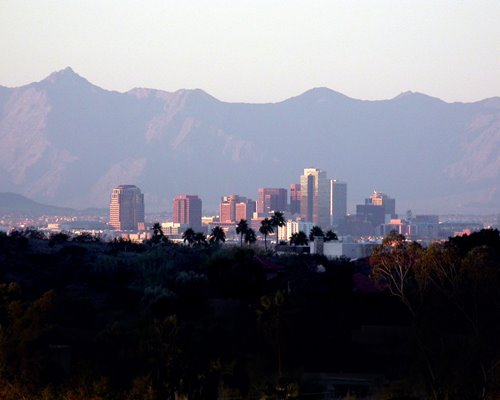
which is the fifth largest city in the United States, and which Marilyn and I know fairly well at this point, since we live two hours north of it and go there frequently. Phoenix is a big, sprawling place. Like much of Arizona, it is surrounded and interspersed with craggy mountains that look blue-gray from a distance. These lend the city its character, such as it is. I will not pretend that Phoenix is a great urban treasure, like Venice or San Francisco, but it is a decent enough place. The climate is hot but not humid, homes are fairly affordable, and the air is clean once in awhile. It has a symphony and an opera and a world-class American Indian museum and one of every major sports franchise, even ice hockey. There are at least 15 Vietnamese restaurants now, which is sort of the scale I go by in grading cross-cultural advancement among American burgs. Metropolitan Phoenix is defined as everything within Maricopa County, and includes such cities as Scottsdale, the toniest suburb; Tempe, which is the home of Arizona State University; Mesa, which is bigger than St. Louis but has no there there; and Sun City, the retiree mecca where they roll up the sidewalks at five.

Medium is set in Phoenix because there really is a "research psychic" named Allison DuBois who lives there; and the more Marilyn and I watch the show, the more we realize how careless the writers are about all things Arizona. For those who have never looked at a map, Arizona is adjacent to California, where people in Hollywood produce shows like Medium. It’s not like they’re being asked to describe life on Mars.

By the time I get to Ely

Some of the inaccuracies are understandable enough and simplify things for plot purposes. The name of the county has b
een changed from Maricopa to Mariposa, presumably for liability reasons. Maricopa County has a county attorney, and in Medium this person is known as the “district attorney.” In the show, the mayor of Phoenix and the deputy mayors of Phoenix are always breathing down DA Devalos’ neck. In reality, Phoenix is just one of the cities served by the county attorney, and the mayor of Phoenix has no authority over that attorney. In fact, nobody knows who the mayor of Phoenix is. (OK, it’s Phil Gordon, but nobody cares.)

Beyond this, the sh
ow gets into some things that can only be described as bloopers, small and large. Some are the kind you only notice if you live in the area. In one episode, the University of Arizona is described as being in Phoenix, when it is actually in Tucson, two hours south. Would the writers have placed USC in Fresno? I doubt it. In another episode, one of the DuBois daughters gets an opportunity to speak to the "state Assembly.” California has a state Assembly. Arizona does not. It has a state House and a state Senate, collectively known as the state Legislature. In yet another episode, Phoenix police respond to a call in Scottsdale. Would the writers have had the LAPD show up in Long Beach? Again, probably not.

Medium also makes little effort to show what Phoenix looks and feels like, which is why on Medium it feels like Los Angeles. They do try to get in a lot of shots of palm trees, but there is seldom a blue-gray peak, and hardly ever a Southwestern-style ranch house, and no hint of the vast sky and its play of light at sunset. The Medium Phoenix is a bit too verdant, the light is a bit too dim, and Allison is always wearing sweaters and jackets, which people do not do all that often in the hottest metropolis outside Mecca. Allison never gets in her car in the summer, touches the shift lever, and screams in pain.

The worst blooper I have seen (so far) occurs in an episode where a killer is descr
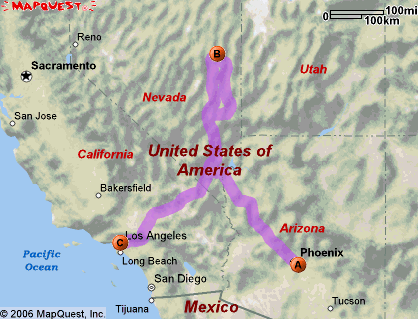
ibing the route he took while driving from Phoenix to Los Angeles with a victim. At one point he starts waxing about “where the road turns into one lane.” Perhaps in 1906, but not 2006, where something known as Interstate 10 connects the two metropoli. Worse yet, he goes on to use the phrase “by the time we got to Ely, Nevada.” I have included a map here showing the route from Phoenix to LA via Ely, Nevada. Does anybody check facts on the show? Or do they simply not care?

The larger relevance of these mistakes is that they call into question just how much
Hollywood gets wrong about everything everywhere.

"Facts are stupid things" -- Ronald Reagan

As the brouhaha about the ABC movie The Path to 9/11 shows, accuracy in the portrayal of events is crucial when it comes to the writing of history. (Rewriting history is easy, but it is an affront to those who died in the making of it.) Accuracy is certainly more important in a project that purports to tell what really happened in the run-up to a major terrorist attack than in a TV show about a psychic. But I wonder if all this isn't symptomatic of an underlying disease in which our society has become too careless with the facts. I used to be a newspaper reporter and editor, and I was trained with the idea that you did not just accept someone’s word about something, you double-checked the “facts” that were presented to you before running with the story. This was a sacred tenet of the work. If one didn't always do it well, one always made the effort.

If I had stayed in journalism, I would have slit my wrists by now. The most recent example of a media that didn’t do its job is the case of John Mark Karr, the pathetic loser who claimed he killed JonBenet Ramsey. A little healthy skepticism, and some digging, might have nipped this in the bud a little sooner, or at least presented some balance to the piece. Yes, there were a few doubters, notably Dan Abrams on MSNBC. But for the most part we were treated to a spectacle in which inane details, like how many times Karr got up from his seat on the plane to LA to use the bathroom, became the news of import. Infotainment is replacing hard news, and i
n the span of a generation we have gone from Walter Cronkite to Katie Couric. “Journalist” has come to mean “newsreader.” In such an environment, what really happened on the road to 9/11 can be forgotten if it is inconvenient to the plot -- or point -- that a particular writer or director is trying to make. We live in a state of fiction masquerading as fact. (I have no problem with people taking particular views, but label them as such -- "editorial commentary" or "opinion" -- and if I may quote my favorite jurist, Judy Sheindlin, don't pee on my leg and tell me it's raining.)

The signs are ominous: with so many competing media outlets that need to fill never-ending news (and entertainment) holes that are as big as black holes, we cannot be bothered with accuracy, with fact-checking, with getting something right. (Ironically, the more cable news channels, the less actual news reported.) In a world of spin, truth has become a relative
thing.

This is most tragic in the news division. The television media especially seem to lack the fortitude or even the basic talent to question what they are fed. The result is a regurgitation of spin from one side or the other, thus compounding inaccuracy and confusion. No wonder the American p
ublic mistrusts the media almost as much as it does politicians.

Media laxity and herd-think has done our country another great disservice. Without launching too far into another tangent, let me say that the press did not do its job in the run-up to
the Iraq War. We are now paying the price for the Fourth Estate’s cowed cheerleading. I am Joe Blow sitting out here in the middle of the desert and I smelled a strategic and political rat from the very beginning. Did anyone of influence in the major media take a detached, critical view of the situation in 2002 and early 2003? Friday afternoon’s news dump was a report by the Senate Intelligence Committee that showed there was no connection between Saddam Hussein and Al-Qaeda -- in fact, Saddam distrusted Al-Qaeda -- and that the Bush Administration had been told this by intelligence services before it went to war. Surely some enterprising reporters could have gotten somewhere near the bottom of this a little bit closer to the event. And now we learn this how many lives later?

But back to Medium. It’s a good show. It’s entertaining. It’s not accurate about the place in which it is set, but it would seem we Americans no longer prize accuracy above expediency. In TV-land, this is merely annoying. In the real world, the consequences can be damning.

Monday, May 22, 2006

Goodnight, sweet prince

Pyewacket, 1987-2006

The first cat I ever knew who preferred love to food. He has been one of the greatest blessings in our lives. He was our companion, our friend, and our fellow explorer. May your journey be a good one, my sweet Pye, and may we meet again.

Friday, April 07, 2006

Customer disservice

It happened again the other day. I heard Marilyn, down the hall, talking on the phone.

"Customer service," she said.

Then a little louder: "Customer service!"

Then screaming into the phone:

"CUSTOMER SERVICE!
CUSTOMER SERVICE!!
CUSTOMER SERVICE!!!"

Marilyn was trying to navigate one of those automated voice menus that you reach almost every time you call a credit card company or a bank or a department store. This one was voice-responsive, or so it claimed.

"Which department do you want?," the disembodied voice had asked her. "For 'customer service,' say 'customer service'. "

Which Marilyn was trying to do, and the irony of the situation was not lost on me.

Fortunately, there is a website out there run by people who have gotten fed up with having to suffer through endless menus that ask us to "say or press 1" for this and that, with the result of being navigated to even more menus, all of which become an annoying blur and raise one's blood pressure.

So, as a public service, allow me to present http://www.gethuman.com/. The site has a database of workarounds for various companies, as well as some tips on how to get through to a human being wherever you call.

And, yes, this is health-related. Stress has been shown, anecdotally at least, to raise one's lymphocyte count. High blood pressure can lead to heart attack or stroke. Think of this as a medical necessity.

Thursday, March 23, 2006

Six rains

The first rain quiets the din of the earth
It brings with it a lacquer of indifference
It obeys only gravity, or it would fall up
and coat the heavens.

The second rain comes in the jacketed night
It enters the house, washes away the foundation
Climbs up the stairs and makes a mist of your visions
Leaves stains in the bed where you had been.

The third rain cracks ground with a shattering wetness
Cities subsumed in mud-flow ravines
Wobbling stars in a broken-back night
By day, the sun is as blue as the sea.

The fourth rain, the fourth rain, is green and sweet-smelling
It comes and fills up the things that it touches
The woodwork, the stonework, the flowers, the children
Inside, it courses and sits in low pockets.

The fifth rain is rhythm and chants, incantations
A begging of heavens, a washing insistence
A random commital of calls on the wakened
It pulls things up past the clouds in the sky.

The last rain comes once, on a clear day of sunlight
Logic disputes its very existence
It drops in the eyes and the ears of one person

Runs into the mouth, and paints exhalations.

Friday, March 17, 2006

Fetch

A woman, flat-chested like a man; two dogs
lie before her like lions
at the gates of a palace.
Stately, big paws, steady gaze
Panting
Streaming spit on the beach.

A stick
behind her back
A few words,
and a few words more,
and the lecture concludes, and
she tosses the stick
ever so gently.

Dogs leap
-- the statues break --
They run for it
A twelve-foot DASH.
Trot back, one the victor
Lie politely
Surrender the stick
Drool

She nods and smiles like Queen Elizabeth
And talks, comments, commends

Addresses her parliament of dogs
Drool
Drool

Dogs at the pace of croquet.

Thursday, March 16, 2006

Eminem meets Emily Dickinson

I have in front of me a display ad from our local entertainment weekly newspaper.

“Poet for hire” it reads. “To perform at your social gatherings, workshop facilitator, home schooling, poetry coach, set free your Robert Frost to perform like Mick Jagger.”

That last one grabbed me. I’m not sure I want my Robert Frost performed like Mick Jagger. Or my Emily Dickinson rapped like Eminem. Or Yeats done by the finalists from American Idol.

But I am impressed that the young man hopes to make some kind of living at being a poet. (I know it’s a man because his name is at the bottom of the ad, and I know he’s young because no one with any experience of life’s monetary obligations would have illusions about the financial potential of poetry.) Apparently he is a “Grand Slam Champion.”

If “grand slam” brings to mind golf or baseball or breakfast at Denny’s, you are sorely out of touch.

Poetry has become fashionable these days, which, considering all the other possibilities, is a good thing. College-age kids are participating in poetry slams, contests where people recite their work before an audience. I have never been to one of these; I’ve seen one on television. Perhaps I’m showing my age, but I have always regarded poetry as a private affair, something that doesn’t want to be shouted or judged in a contest. A good poem is a personal statement that needs time to sink in, time for one to dawdle over phrases and words, and for one to sit back and reflect. A poem is meant to be read and reread while sitting in a cushy armchair, in the perfect quiet late at night, perhaps a glass of Scotch at your side. At least that’s how I see it.

I have not written a poem in 15 years. I never wrote very many of them, but when I lived near the beach on the Oregon coast for a few years, I was inspired to do so. Maybe it was the waves, ever calming, that led me to a more reflective bent. Their eternal rhythm is ripe ground for thinking in rhythmic ways.

The other day, I found my file of poems from that era and I will post some of them here. And who knows, I may try my hand at a new one. Or two.


It’s not like I am a Grand Slam Champion or anything, and I have no clue how good or bad my poems are, really. Some attempt to say something deep, some are meant to paint a picture in words of a scene that captured my imagination, some are humorous throwaways. Back then, my mind wandered everywhere from mystical rains to a dead hippopotamous. It was before CLL. But the more things change, the more they stay the same. Rereading the poems, my outlook on life and death is much the same today as it was then.

Saturday, February 04, 2006

ei8ht is enough

The information explosion has kaboomed all over my TV set, like a swarm of bugs that hit your car windshield and squash themselves in front of your view.

For some time now, the sensibilities of viewers have been assaulted by those little bugs -- actually, symbols of networks such as the CBS eye -- that appear in the lower right of the screen and stay there for the duration of the program.

I have learned to live with this senseless bit of advertising, for the most part, especially in cases where it is shadowed enough to be barely discernable. It’s become an annoying fact of life, like getting sand in your swimsuit at the beach.

My local PBS affiliate had been using the little PBS head, which I was managing to accustom myself to, though I wonder why a nonprofit public broadcasting entity needs to use such reminders. Silly me. Their graphics department has now gone completely insane.

I tuned in last night to watch my favorite collection of political blowhards, The McLaughlin Group. There, almost completely obscuring Pat Buchanan, who sits in a chair on the lower right, was a new constellation of crap. While obscuring Pat Buchanan may not be such a bad thing, really, this was over the top. On the left side of the constellation was the PBS head. To the right was the station’s new logo -- ei8ht -- in large letters. Oh, how clever to make the “g” look like an “8” since this is Channel Eight! (The kids watching Sesame Street ought to have fun with that one . . . “But mommy, the TV says you spell “eight” with an “8” in the middle!”)

What genius at Arizona State University thought of this? How do I know Arizona State University is involved? Because below the “ei8ht” and the PBS head was written, in its glorious entirety, “Arizona State University.” It looks worse on the TV screen -- where "Arizona State" is on one line and "University" is below it -- than it does in the illustration here.

How much more crap can they put on the screen before they start covering Eleanor Clift as well?

To top it off, several times during the show a few zingy notes of music could be heard interrupting Mr. McLaughlin, accompanied by an orange band flashing across the screen announcing: “Next: Antiques Roadshow.”

The USA network already does this, with obnoxious animated images in the lower left corner promoting their next program. I only watch USA for Monk, so I could care less what’s on next.

Where will this trend end? Which station will be the first to rent out the upper right corner to Pepsi or Kentucky Fried Chicken? Will Fox News finally drop its pretense of “fair and balanced” reporting and put the Republican elephant on the upper left?


It almost makes me pine for the old days when TVs had knobs and you could forget what network you were watching and simply enjoy the program. What a revolutionary concept. Maybe some day it will catch on.